The Cyberwellness Score Framework: A Practical Guide to Comfort & Motion Risk in Immersive Experiences


The Cyberwellness Score Framework: A Practical Guide to Comfort & Motion Risk in Immersive Experiences
The Origin of the Cyberwellness Score
The Cyberwellness Score was created in response to a moment that was both surprising and instructive for the Cognitive3D team.
As a remote company, the Cognitive3D team meets up in virtual reality every couple of weeks to spend some time together outside of the work environment. At one of these team-building exercises, the group decided to play a VR game they had all been genuinely excited about trying out. The experience itself was engaging, well-designed, and enjoyable from a gameplay perspective. However, within just a few minutes of entering the environment, every team member began to feel nauseous. No one was able to remain in the experience for longer than three minutes.
What made this especially striking was that this was not a group of new or inexperienced VR users. The team regularly works in immersive environments and is well adapted to VR. This ruled out user inexperience as the cause and made it clear that the issue lay in the design and performance characteristics of the virtual environment itself.
That experience highlighted a critical gap. There was no objective, scalable way to identify why an experience that was otherwise well made could make users feel sick. Usability issues were often discovered only after users disengaged, opted out, or stopped returning altogether.
The Cyberwellness Score was created to address this gap. It exists to surface the underlying performance and movement patterns that contribute to cyber sickness, so teams can identify risks early, understand their causes, and design immersive experiences that people actually want to stay in.
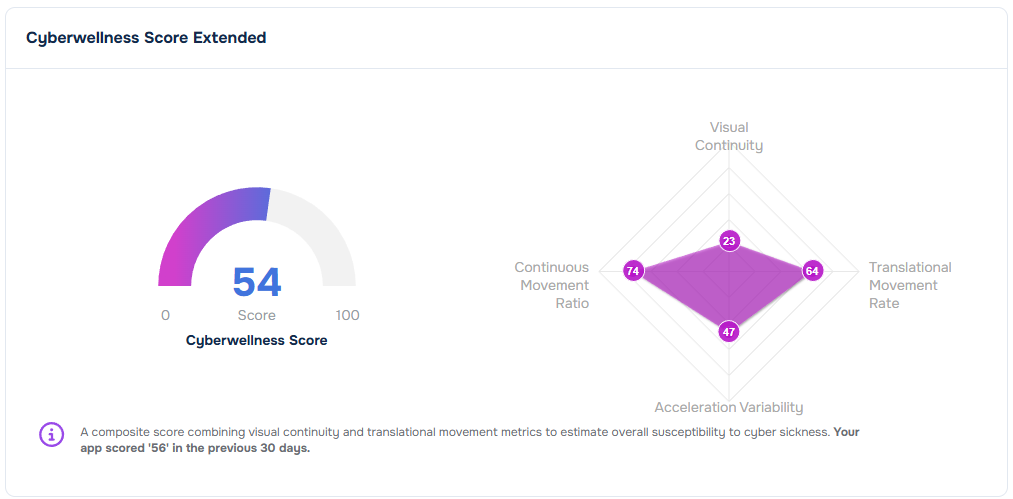
The Cyberwellness Score measures how likely an immersive experience is to cause discomfort or cyber sickness. It is designed to help teams identify experience-level risks that can lead to user drop-off, reduced effectiveness, or negative sentiment.
Rather than relying solely on subjective feedback or post-session surveys, the score uses behavioural and performance signals collected during a session to surface patterns that are well established contributors to nausea, disorientation, and fatigue in immersive environments.
At a high level, the score focuses on two core contributors to user comfort:
- Visual Continuity, which reflects how visually stable and responsive the experience feels, particularly during moments of degraded performance.
- Translational Movement, which captures how users move through virtual space and the extent to which that motion creates sensory conflict.
1. Visual Continuity
What it Captures
Visual Continuity reflects how stable and smooth the experience feels during its most fragile moments. Short periods of low frame rate, stuttering, or dropped frames tend to be far more noticeable to users than average performance metrics suggest, and these brief disruptions often have an outsized impact on comfort and presence.
By emphasizing worst-case visual stability rather than overall averages, this component is designed to capture the moments most likely to trigger discomfort.
Why it Matters
When visual updates lag behind head or controller movement, users experience a mismatch between their physical expectations and what they see in the headset. This mismatch can quickly lead to discomfort, disorientation, and a loss of trust in the experience. Even if these issues occur only briefly, users often remember the discomfort more strongly than the content itself.
Practical Implications and Examples
In training and enterprise environments, poor visual continuity can cause employees to disengage from required training or request exemptions altogether. Discomfort during training sessions can also reduce focus and retention, undermining the effectiveness of the program and wasting development investment.
In games and entertainment experiences, visual instability is a common reason players quit mid-session or decide not to return. A single uncomfortable experience, especially during a high-intensity or memorable moment, can permanently shape a player’s perception of the game.
In simulation and research contexts, inconsistent visual performance can shorten session duration, increase participant fatigue, and introduce unwanted variability into experimental results.
How Teams Use this Signal
Teams use Visual Continuity to identify performance regressions between builds, compare comfort across devices or hardware tiers, and validate that optimization work improves not just average frame rate, but the moments that matter most to user comfort.
2. Translational Movement
Translational Movement focuses on cyber sickness caused by how users move through virtual space, particularly when visual motion does not align with physical sensation. This subscore examines not just how fast users move, but how smoothly and consistently that movement occurs, as well as the overall movement style used by the experience.
2.1 Movement Speed
What it Captures
This component reflects how quickly users move through the virtual environment over the course of a session. Rather than focusing on short spikes in speed, it emphasizes typical movement behaviour to represent how the experience generally feels moment to moment.
Why it Matters
Faster visual motion increases the intensity of sensory conflict between what users see and what their vestibular system perceives. Sustained high-speed movement can overwhelm even experienced users, increasing the likelihood of nausea and reducing how long users are willing to remain in the experience.
Practical Implications and Examples
In training and safety simulations, excessive movement speed can cause users to rush through environments, disengage from instructional content, or opt out entirely due to discomfort. These effects are especially pronounced for new or infrequent VR users.
In games, high movement speed may initially feel exciting but can significantly shorten session length. Players may avoid certain levels, modes, or locomotion options if they associate them with discomfort.
In location-based or shared experiences, faster movement can reduce throughput by shortening sessions and may negatively impact brand perception if visitors associate the experience with nausea.
How Teams Use this Signal
Movement Speed is commonly used to compare locomotion modes, tune traversal systems, and balance excitement against comfort. It allows teams to make informed adjustments without relying solely on user complaints or post-session feedback.
2.2 Acceleration Variability
What it Captures
Acceleration Variability captures how smooth or erratic movement feels by examining how frequently and how sharply movement speed changes throughout a session. It reflects whether movement feels smooth and predictable or sudden and unstable.
Why it Matters
Users generally tolerate steady motion far better than unpredictable motion. Sudden starts, stops, or frequent speed changes amplify sensory conflict and can make users feel as though they are not fully in control of their movement, increasing discomfort even when average speed is relatively low.
Practical Implications and Examples
In training environments, erratic movement can distract users from task execution and reduce confidence in the system. Users may focus more on managing discomfort than on learning objectives.
In games, abrupt changes in movement, often during combat or traversal, can trigger nausea and lead players to attribute discomfort to poor controls or camera design.
In simulation or research settings, high acceleration variability can compromise realism and reduce participants’ ability to maintain focus during longer sessions.
How Teams Use this Signal
Teams use Acceleration Variability to diagnose locomotion tuning issues, compare smooth versus snap-based movement systems, and improve comfort without necessarily reducing overall movement speed or freedom.
2.3 Movement Style (Continuous vs. Discrete)
What it Captures
This component estimates whether movement within an experience is primarily continuous, such as smooth locomotion, or discrete, such as teleportation or step-based movement. It provides insight into the overall movement philosophy of the experience.
Why it Matters
Continuous movement is often more immersive, but it is also more visually provocative and more likely to induce cyber sickness. Discrete movement techniques are widely adopted because they reduce sensory conflict and tend to be more comfortable for a broader range of users, particularly those new to VR.
Practical Implications and Examples
In training and onboarding scenarios, heavy reliance on continuous movement can increase early dropout, especially among first-time users. Providing discrete movement options can significantly improve comfort and confidence.
In games, offering teleportation or alternative locomotion styles can meaningfully improve retention and accessibility. Players who feel uncomfortable are more likely to stop playing entirely than to push through discomfort.
From an accessibility perspective, movement style choices directly affect who can comfortably use an experience. Experiences that rely exclusively on continuous movement may unintentionally exclude users with higher sensitivity to motion.
How Teams Use this Signal
Movement Style data helps teams evaluate locomotion design decisions, justify offering multiple movement options, and track how different movement styles impact comfort across user groups and experience types.
Why This Matters Overall
Cyber sickness is not just a comfort issue; it directly affects outcomes and adoption. In training, discomfort leads to opt-outs, reduced learning effectiveness, and diminished return on investment. In games, it drives churn, negative reviews, and lost lifetime value. In simulation and research, it compromises data quality and limits session duration.
The Cyberwellness Score provides teams with an objective, actionable way to identify comfort risks early, compare experiences across builds and devices, and make informed tradeoffs between immersion and user comfort.