From Questions to Insight: Introducing the Cognitive3D MCP Server


From Questions to Insight: Introducing the Cognitive3D MCP Server
For over a decade, Cognitive3D’s spatial analytics has helped organizations understand how users behave inside immersive environments.
Now, we’re transforming how you access those insights.
Cognitive3D is proud to introduce the Cognitive3D MCP (Model Context Protocol) Server: the first MCP Server built specifically for spatial analytics. This new offering changes the way teams interact with their XR data. Instead of navigating dashboards, exporting reports, or writing API queries, you can simply ask a question and get an answer.
A New Way to Access XR Intelligence
Until now, accessing immersive analytics required time, training, or technical expertise. Even when dashboards are intuitive, insight discovery still requires knowing where to look and how to filter the data.
With the Cognitive3D MCP Server, your AI assistant becomes a secure bridge to your spatial analytics.
You can ask:
- “How are my project objectives performing?”
- “Summarize exit poll feedback from last quarter.”
- “Which training modules have the highest completion rates?”
- “Are there engagement differences between locations?”
- “How do projects A and B compare in terms of performance and outcomes?”
Behind the scenes, your LLM securely communicates with the Cognitive3D MCP Server using the Model Context Protocol. The server retrieves structured data directly from your organization’s analytics via the Cognitive3D API. The AI then combines that structured response with reasoning to deliver a clear, conversational answer.
The result is immediate clarity without technical friction.
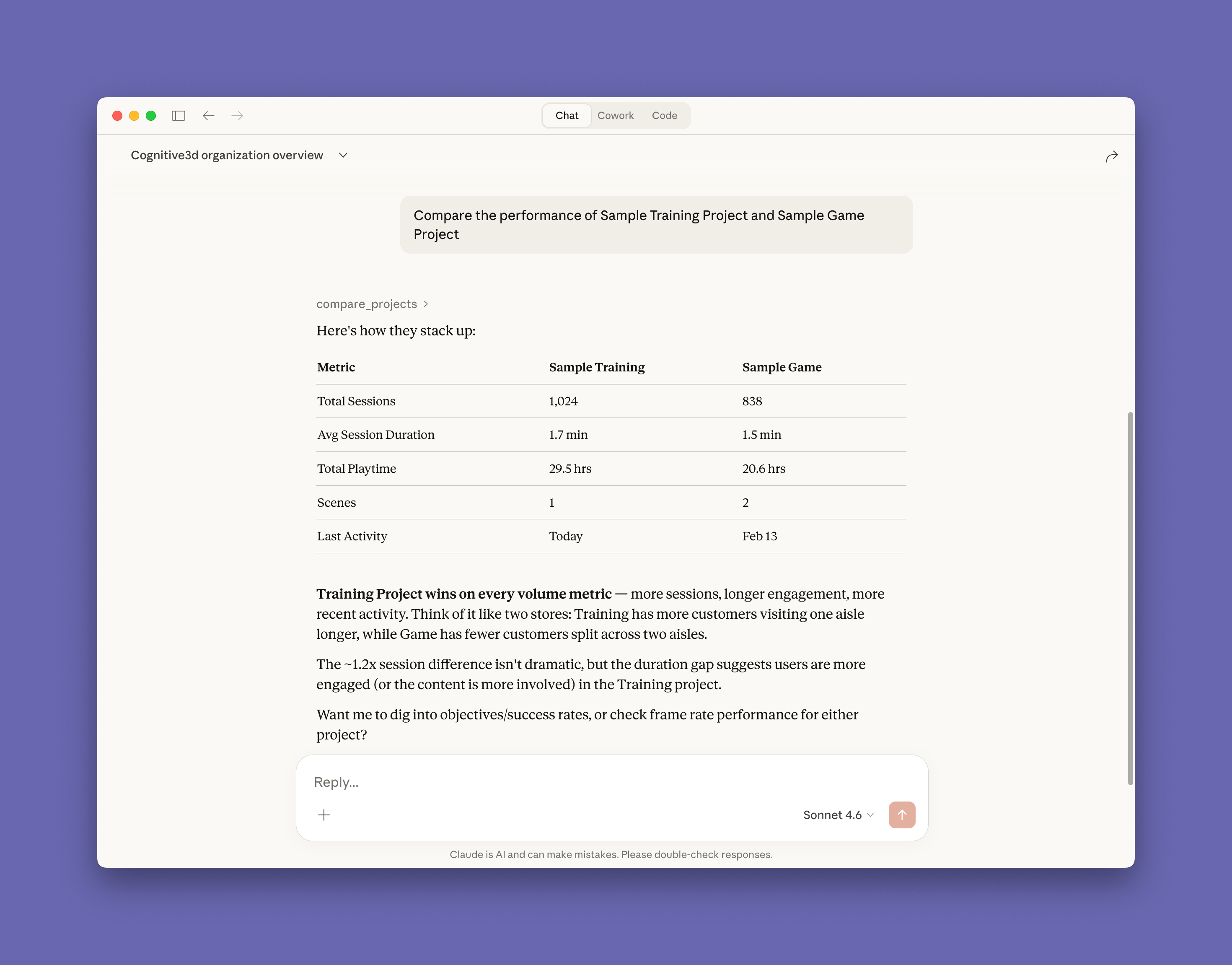
The First MCP Server for Spatial Analytics
We believe this represents a milestone for the XR industry.
Cognitive3D is the first spatial analytics company to offer an MCP Server, enabling AI systems to interact with immersive analytics in a standardized, secure, and scalable way. This is not a chatbot layered on top of dashboards. It is a structured communication layer that allows AI to reliably request and receive specific analytics data.
What makes this powerful is not just the technology itself, but the flexibility it unlocks. There are no predefined limits to the types of insights you can explore. The true boundary is your creativity and the questions you’re willing to ask.
Designed for Business Users, Not Just Developers
One of the most transformative aspects of the MCP Server is accessibility.
Business leaders, training managers, researchers, and product owners often rely on technical teams to extract or interpret analytics. Although dashboards are available, navigating data sets can sometimes slow decision-making.
The MCP Server removes that barrier.
By allowing natural language access to your organization’s XR data, it empowers non-technical users to directly explore outcomes, performance metrics, objective completion rates, and user feedback. There is no need to understand API schemas or build custom integrations. The experience feels intuitive because it mirrors how people already think: ask a question, receive an answer.
At the same time, the system remains robust enough for technical teams. Responses are structured in JSON before being translated into natural language, ensuring data integrity, automation potential, and extensibility for more advanced workflows.
It’s powerful without being complicated.

Secure and Scoped to Your Organization
Enterprise-grade security remains foundational to everything we build at Cognitive3D and the MCP Server is no exception.
Access through the MCP Server is strictly limited to your organization’s data. Every request operates using your organization’s private API key, ensuring that only authorized projects, sessions, and analytics can be retrieved. There is no cross-organization exposure.
Importantly, the MCP Server maintains the same access controls and governance framework as the Cognitive3D platform itself. That includes adherence to our existing security standards and SOC 2 Type 2 compliance. The MCP Server does not bypass or weaken platform permissions, it operates within them.
Your organization retains full control over what data is accessible and how it is queried. If a dataset or project is not available through your API key, it is not available through the MCP Server. Conversational access does not mean unrestricted access; it means structured, authenticated, and permission-bound access.
AI-driven insight should expand what you can do with your data, not expand who can see it.
How It Works
The experience feels simple because the complexity is handled behind the scenes.
When a user asks a question in natural language, their AI assistant structures that request using the Model Context Protocol (MCP). Rather than sending an open-ended query, the LLM generates a structured, machine-readable request that specifies exactly what information is needed, e.g. project objectives, engagement metrics, or exit poll summaries.
That structured request is sent to the Cognitive3D MCP Server.
The server validates the request, authenticated using your organization’s API key, and translates it into one or more secure calls to the Cognitive3D API. These API calls retrieve the relevant analytics data, whether that’s objective performance statistics, user engagement trends, session metrics, or qualitative feedback data.
The MCP Server then returns a structured JSON response back to the AI assistant. This response is enriched with clearly defined fields and context, ensuring the AI is working with accurate, well-scoped data rather than making assumptions.
Finally, the AI assistant combines that structured response with its reasoning capabilities to generate a clear, conversational answer tailored to the user’s original question.
What once required navigating dashboards, exporting CSV files, or writing custom queries now happens in seconds, through a standardized, secure communication layer designed specifically for spatial analytics.
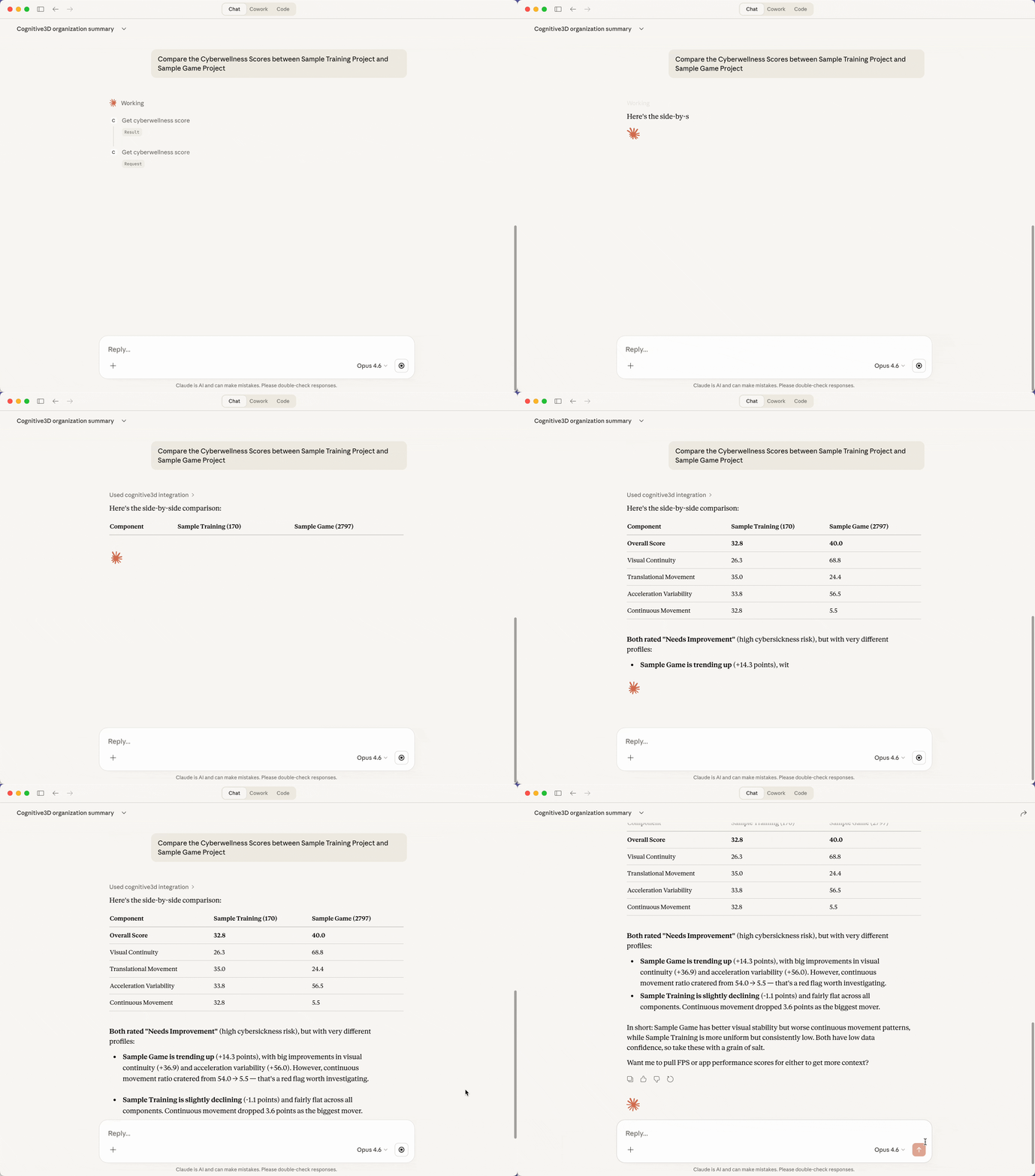
The Future of Spatial Analytics Is Conversational
Dashboards will always have value. But the way organizations interact with data is evolving. Increasingly, teams expect insights to meet them where they work: inside AI assistants, workflows, and collaborative tools.
By launching the first MCP Server in spatial analytics, Cognitive3D is introducing a new interface for XR intelligence. One that reduces friction, empowers non-technical stakeholders, and integrates immersive analytics into the broader AI ecosystem.
The most exciting part is not a single feature, it’s the freedom to explore.
Because the next breakthrough insight might begin with a simple question.