Capturing 3D Environments: Turn Real-World Spaces into Measurable Digital Worlds


Capturing 3D Environments: Turn Real-World Spaces into Measurable Digital Worlds
You Can’t Design What You Can’t Capture
Every XR experience, from a training simulation to a virtual walkthrough, starts with one thing: the space.
The walls, lighting, and layout form the stage for every user action. But when that space is captured inaccurately, everything else falls apart. Scale feels wrong. Movement feels awkward. Data stops making sense.
In many XR workflows, teams start with approximate 3D models or simplified mockups. It’s an understandable shortcut; scanning real-world spaces has traditionally been time-consuming or inconsistent. But those shortcuts compound.
In XR, accuracy is empathy. The more precisely you capture a space, the more naturally users move, react, and engage inside it. That is where Cognitive3D’s ability to capture 3D environments becomes a significant asset.
When Virtual Isn’t Real Enough
The problem isn’t just visual fidelity, it’s measurable trust.
When your digital space diverges from the physical world, every data point that follows is compromised. Heatmaps, gaze tracking, and task completion rates can all lose relevance because they’re not grounded in spatial truth.
This disconnect creates invisible friction. Review meetings devolve into debates about alignment instead of insights. Designers second-guess whether behaviour patterns are meaningful or simply side effects of a flawed environment.
Even small spatial errors can cascade:
- A misplaced object causes inconsistent task times.
- A misaligned surface skews gaze or interaction data.
- A scale mismatch distorts distance-based metrics.
When spatial accuracy is lost, XR stops being a precision tool and becomes a best guess. And in industries where precision drives performance, from manufacturing to healthcare, guessing simply isn’t good enough.
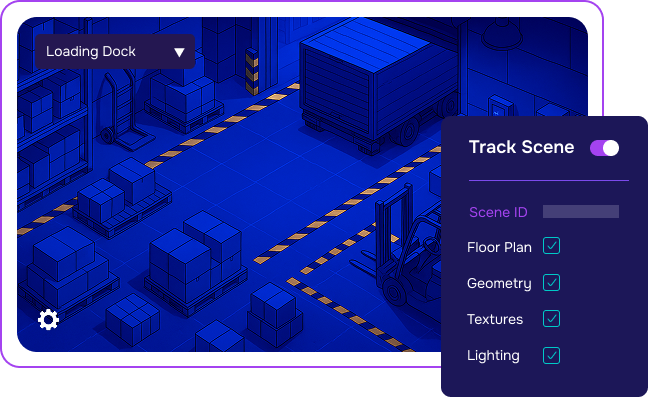
“Creating Certainty in Every Immersive Experience”
“We built our environment capture tools to give creators total spatial confidence. When you start from truth, everything else becomes faster, smarter, and more believable.”
— Tony Bevilacqua, CEO, Cognitive3D
At Cognitive3D, this idea sits at the core of every feature: you can’t optimize what you can’t define.
By anchoring spatial analytics in accurate environmental capture, Cognitive3D gives teams the certainty to trust what they see, and the freedom to innovate without hesitation.
From Guesswork to Ground Truth
Capturing a 3D environment isn’t about creating a prettier map, it’s about establishing context.
Cognitive3D’s ability to capture 3D environments transforms real-world locations into precise digital frameworks that power measurable behaviour analysis. Every surface becomes a reference point; every object, a potential insight.
Here’s what that shift looks like in practice:
- Training teams can validate if users actually move through a virtual workspace as intended.
- Designers can visualize how environmental layout impacts attention and engagement.
- Enterprises can replicate and measure safety, workflow, or operational performance in digital twins before touching real-world assets.
It’s not just about replicating space. It’s about understanding it.
With Cognitive3D, spatial data becomes the language of improvement.
Data That Proves the Difference
When organizations begin capturing environments accurately, a clear pattern emerges: every downstream metric improves. Not because teams work harder, but because they finally trust their foundation.
Across Cognitive3D’s customer base, the relationship between spatial fidelity and analytic reliability is direct and repeatable. Companies that invest in capturing their real-world spaces see a fundamental shift in how they make decisions about their XR content.
Here’s what we consistently see:
1. Less time spent fixing context & more time learning from it.
Before accurate capture, many teams spend the majority of their time calibrating: testing whether the digital layout matches reality, adjusting positions, or questioning why gaze data looks inconsistent.
Once they transition to a captured environment, those calibration debates disappear. Teams can start reviewing behavioural insights on day one rather than debugging geometry.
2. More meaningful analytics.
When environments align perfectly with physical reality, data like heatmaps, gaze traces, and dwell times suddenly carry deeper meaning. A red hotspot in a corner isn’t an anomaly anymore, it’s a moment of friction in a real, spatially grounded location.
Designers can confidently act on the story their data tells because it reflects authentic human behaviour within a verified space.
3. Fewer blind spots in collaboration.
Spatial accuracy doesn’t just improve what’s measured, it improves how teams communicate. Review meetings move away from subjective arguments toward data-informed decisions
This shared visual context grounded in a real environment builds alignment across engineering, design, and leadership.
4. Faster iteration cycles.
With an accurate baseline, each new experiment or design iteration starts clean. There’s no need to rebuild or re-verify the environment before testing new features or layouts.
This accelerates learning loops and reduces the cost of every experiment, because each dataset remains comparable and cumulative.
5. Trust that scales across projects.
Once a team experiences the benefits of working with captured environments, it becomes their default expectation for all future XR initiatives.
The data is cleaner, onboarding is smoother, and outcomes are more predictable. In short, the quality of their spatial understanding becomes a competitive advantage.
Cognitive3D’s environment capture capabilities don’t just enhance visuals, they enhance the credibility of the insights that XR produces.
That credibility is what turns immersive analytics from a novelty into a necessity, and what transforms spatial data into a shared language across the enterprise.
When you begin with reliable data, every layer that follows (the analytics, optimization, and storytelling) compounds in value.
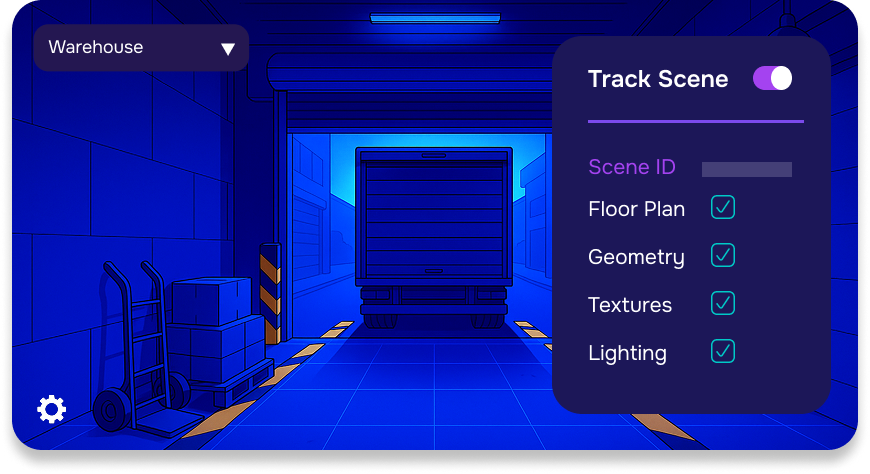
How Cognitive3D Captures Reality
Cognitive3D connects directly to leading scanning and spatial mapping solutions, transforming raw geometry into structured, analyzable data.
This includes:
- Geometry capture: Accurate reconstruction of physical layouts and surfaces.
- Spatial anchoring: Linking key objects and regions to behavioral analytics.
- Context tagging: Adding metadata to spaces for dynamic filtering and insights.
Once your environment is imported, it becomes an active analytics layer. Developers and analysts can overlay heatmaps, gaze trails, and performance metrics, all within the actual 3D space.
The result: clarity. You’re no longer interpreting graphs detached from context. You’re seeing data come to life inside the world it describes.
Analytics in the Real World
Across the XR landscape, teams describe a similar turning point once they begin capturing environments with Cognitive3D.
Before adopting environment capture, many creators faced the same challenge: they could design beautifully rendered experiences, but they couldn’t be certain how closely those spaces matched the real world. That uncertainty rippled through every stage of production, from planning and testing to measurement and iteration.
After introducing accurate 3D capture, that uncertainty disappears. Teams can validate their spaces instantly, compare digital and physical layouts with confidence, and refine their experiences before they ever reach deployment. What once required weeks of trial and error now happens in a single review cycle.
This shift isn’t limited to one industry or use case. It’s happening wherever immersive experiences are being built.
Whether that’s for training, collaboration, or customer engagement. What unites these teams is a new sense of spatial confidence. They can trust their data, align faster, and move from speculation to certainty.
The result is consistent: smoother workflows, stronger outcomes, and immersive experiences that don’t just look real, they feel real.
This kind of transformation is now common across industries: from healthcare organizations training surgical teams in true-to-scale operating rooms, to construction firms visualizing design safety in digital twins of real sites.
In each case, accurate capture replaces uncertainty with measurable control.
From Capture to Insight
Once your environment is captured, you’re ready to move beyond visualization into behavioural understanding.
By pairing accurately captured 3D environments with Cognitive3D’s Session Replay, you can watch how real users move through real spaces virtually.
Imagine replaying a training session, seeing exactly where a trainee hesitated or looked for guidance, and then correlating those behaviours to environmental design.
That’s not just powerful data. It’s a continuous feedback loop between spatial design, human behavior, and measurable improvement.
When Data Mirrors Reality, You Design with Confidence
When your virtual and physical worlds align perfectly, teams stop arguing about “what happened” and start acting on why it happened.
You gain the confidence to:
- Iterate faster without revalidating every dataset.
- Present insights that everyone, from engineers to executives, can understand visually.
- Trust that your XR analytics are grounded in the same reality your users inhabit.
This is the emotional payoff: clarity.
With Cognitive3D, your environments don’t just exist, they speak.
See Your Space in Data
Ready to see your space with clarity?
Start capturing, visualizing, and analyzing your 3D environments with Cognitive3D.
No hardware lock-in. No setup friction. Just actionable, spatially accurate data that powers better XR outcomes.
Start Capturing Your Environment →