Record XR Sessions: See the Behaviour Behind the Metrics


Record XR Sessions: See the Behaviour Behind the Metrics
Immersion Without Visibility Is Incomplete
Every XR initiative is designed with intention. Teams build immersive environments to train more effectively, simulate complex scenarios, or create experiential product interactions that mirror the real world. Success criteria are defined. Metrics are configured. Performance is measured.
But immersive environments introduce a challenge traditional software does not: once a session ends, the lived experience disappears.
Dashboards and reports remain, and trends can be analyzed. Yet the actual sequence of movements, hesitations, decisions, and interactions that produced those outcomes is gone, unless it has been recorded.
Without session recording, XR measurement is only partially visible. You can see what happened, but you cannot always see how it happened, and improvement depends on understanding how. By using Cognitive3D's session replay tool, understanding all aspects of activity within the XR environment becomes possible.
Observation Strengthens Measurement
Recording app activity captures structured events across every session. This data fuels dashboards, performance trends, and usage analysis. It reveals where friction exists and when outcomes shift.
However, immersive behaviour is deeply contextual. A longer task time could signal confusion or careful execution. A missed objective could reflect misunderstanding or environmental distraction. A cluster of repeated interactions could represent friction or practice.
Analytics identify the signal but they do not always reveal the story behind it.
When teams rely solely on aggregate data, investigation becomes interpretive. Designers hypothesize about user intent. QA teams attempt to reproduce scenarios. Stakeholders debate what likely occurred inside the headset. Iteration slows because context is missing.
In complex immersive systems, partial visibility creates partial understanding.
Built to Preserve Context, Not Just Capture Events
Session recording was designed to close a fundamental gap in XR analytics: the loss of context. Tracking immersive behaviour is not just about logging discrete events; it is about preserving how those events unfold across space and time. Without that context, even the most detailed data remains incomplete.
In most XR environments, interactions are captured as individual points: a button press, an object interaction, a completed step. These signals are valuable, but they exist in isolation unless they are connected back to the experience itself. What led to that interaction? What happened immediately before or after? Was the user confident, hesitant, or correcting a mistake?
Recording bridges that gap by connecting structured data to lived experience.
Instead of viewing interactions as isolated events, teams can understand them as part of a continuous sequence. They can revisit the exact moment an interaction occurred, see what led up to it, and evaluate how it influenced the outcome of the session. This transforms behavioural data from a collection of signals into a coherent narrative.
That distinction becomes increasingly important as XR environments grow more complex. Spatial orientation, timing, and environmental awareness all influence how users behave. A single action may look correct in the data, but when viewed in context, it may reveal uncertainty, inefficiency, or friction that would otherwise go unnoticed.
Immersive behaviour does not happen in snapshots. It happens in motion, shaped by a series of decisions and reactions over time.
Recording ensures that motion is never lost and that every interaction can be understood within the full experience that produced it.
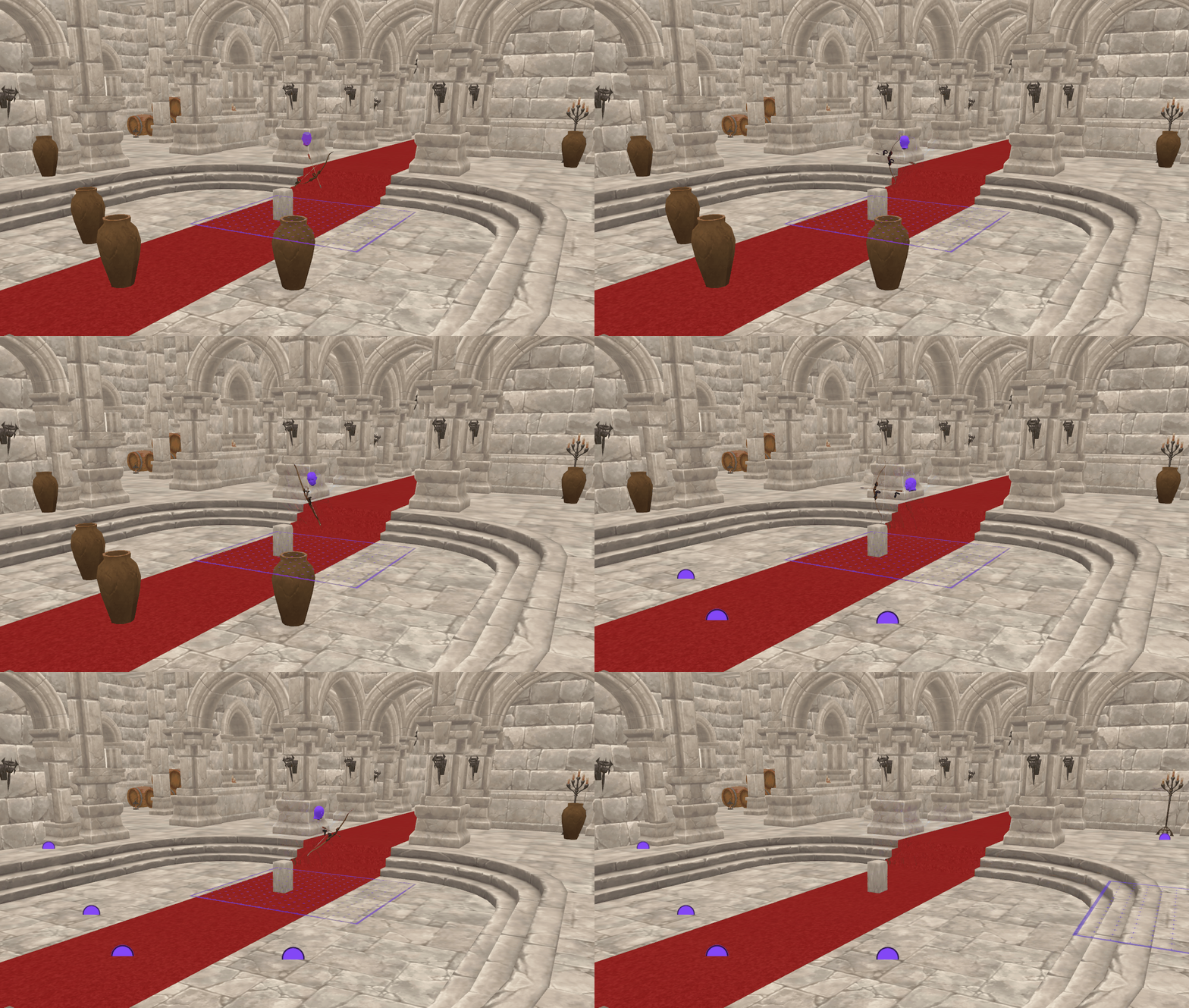
Example of a third-person view of Cognitive3D's session replay tool:
From Data Points to Lived Experience
The shift from recorded events to recorded experience is subtle but transformative.
Inside Cognitive3D, session replay reconstructs spatial interactions across time. User movement, controller input, object engagement, and environmental triggers are preserved in a navigable timeline. Teams can step back into the environment and observe the experience as it occurred.
This is not simple screen capture, it is spatial reconstruction.
In immersive environments, nuance shapes performance. A user may hesitate before interacting with a critical object. They may glance away from instruction panels at the wrong moment. They may reposition themselves before attempting a task again. These behaviours influence outcomes in ways that charts alone cannot fully express.
Session replay transforms abstract metrics into observable reality. Questions that once required speculation can be answered through direct review. The path from confusion to clarity becomes shorter.
Faster Iteration Through Clearer Insight
Across enterprise XR deployments, teams that combine analytics with session recording can resolve issues more efficiently than those relying on dashboards alone. The Cognitive3D session replay tool allows visual understanding above and beyond graphs.
When a performance anomaly appears in a top-level metric, replay allows immediate validation. Instead of forming multiple competing explanations, teams can examine the precise sequence of interactions that contributed to the shift. When individual performance deviates unexpectedly, the complete behavioural path can be reviewed in detail. When goals are missed, the interaction chain leading to that outcome becomes visible.
The advantage is not simply more data, it is contextualized data.
By reducing ambiguity, recording shortens iteration cycles, increases confidence in design decisions, and ensures improvements are rooted in observable behaviour rather than assumption.
Strengthening Confidence Across Teams
XR initiatives rarely exist within a single department. Product teams, training leaders, engineers, designers, and executives all have a stake in performance outcomes. When questions arise, different teams may interpret the same metrics in different ways.
Session recording creates alignment through shared visibility.
Instead of debating what users experienced, stakeholders can review sessions together. Instead of relying on anecdotal summaries, they can observe the environment as the user encountered it. This shared reference point improves collaboration and accelerates consensus.
Over time, this transparency builds organizational trust. Teams gain confidence not only in the experience itself, but in the system used to measure and improve it.
Recording does not just support optimization, it supports credibility.
Connecting Recording to the Larger Measurement System
Session recording is most powerful when viewed within the full Cognitive3D ecosystem.
Behavioural data is captured across sessions, then structured interactions and measurable events are logged. Session recording preserves the experiential context behind those interactions.
From that foundation, higher-level capabilities emerge. Dashboards surface performance trends. Usage analysis reveals long-term behavioural shifts. Individual insights highlight specific user journeys. Goal tracking defines measurable success criteria.
Recording ensures that each layer of analysis remains anchored in observable behaviour. When a pattern appears in a dashboard, it can be traced back to the sessions that produced it. When performance improves, the behavioural changes driving that improvement can be confirmed.
Measurement becomes a continuous, connected system rather than a collection of disconnected reports.
Turning Visibility into Strategic Advantage
In immersive environments, small behavioural nuances often have outsized impact. A slight hesitation can signal unclear instruction. A repeated interaction may reveal friction in spatial design. A momentary distraction can influence task completion rates.
When those nuances are invisible, teams operate reactively. They adjust based on trends, hoping improvements address the root cause.
When those nuances are visible, teams operate strategically. They design with precision. They refine with intention. They validate improvements with evidence.
Recording transforms immersive technology from an opaque system into an inspectable one. It ensures that every insight can be traced to a lived interaction. That level of clarity is not just operationally useful, it can become a competitive advantage for organizations scaling XR initiatives.
When Immersion Becomes Observable
The promise of XR lies in realism and engagement. But realism without visibility limits optimization. If teams cannot see how users navigate, adapt, hesitate, and succeed within the environment, improvement becomes slower and less certain.
Recording XR sessions restores full visibility. It transforms immersive experiences into systems that can be examined, understood, and refined continuously. It ensures that behavioural measurement remains transparent from the highest-level dashboard down to the individual interaction.
In doing so, it strengthens the entire measurement framework. Because effective analytics are not only about capturing events, they are about preserving the experience behind them.
See What Your Users See
For teams investing in immersive technology, understanding performance requires more than surface-level reporting. Dashboards reveal trends, event tracking captures structured interactions, and goals measure success. But none of these layers fully replace the ability to observe the experience itself.
Session recording closes that gap.
By replaying XR sessions, organizations gain direct visibility into how environments are navigated, how instructions are interpreted, and how tasks are executed in practice. Patterns that appear abstract in analytics become tangible when viewed in motion. A delayed completion rate becomes visible hesitation. A missed objective becomes a moment of confusion. A repeated action becomes a signal of friction.
This level of visibility changes how teams improve.
Instead of adjusting environments based solely on aggregated indicators, they can refine them based on observable behaviour. Instead of responding reactively to performance shifts, they can proactively design around real interaction patterns. The conversation shifts from “What do we think happened?” to “Here’s what actually happened.”
Seeing what users see is not about replay for replay’s sake. It is about strengthening the integrity of the entire measurement system. Every insight becomes traceable. Every improvement becomes verifiable. Every performance gain can be connected back to a specific behavioural change.
When immersive experiences remain visible beyond the headset, they become continuously improvable. And that is what turns XR from an innovative tool into a reliable performance engine.
Keep Building on a Stronger Foundation
Session recording is not a standalone capability, it is a strengthening layer within a broader measurement system. Structured app activity tracking captures what users do. Performance dashboards reveal patterns across sessions. Usage analysis highlights long-term behavioural shifts. Individual insights surface specific user journeys. Goal tracking defines measurable success.
Recording ensures that each of those insights remains grounded in observable reality.
When teams can trace high-level trends back to individual sessions, measurement becomes defensible. When improvements are made, their impact can be verified through both metrics and replay. When new environments are launched, performance can be evaluated not only by outcomes, but by how those outcomes were achieved.
Over time, this continuity builds something more valuable than data: confidence.
Confidence that the insights are accurate, that the design decisions are informed, and that the immersive experiences are improving in deliberate, measurable ways.
XR adoption grows strongest in organizations that treat visibility as foundational rather than optional. Recording XR sessions reinforces that foundation. It ensures that immersive technology remains transparent, analyzable, and continuously improvable as it scales.
Because sustainable progress in XR does not come from isolated insights. It comes from systems that connect behaviour, context, and performance into a single, coherent picture.
See your experience the way your users do and turn every session into an opportunity to improve. Reach out to our sales team if you’d like to explore how session recording can fit into your XR workflow.