Introducing Data Pipelines: Bringing XR Analytics Into Your Own Data Stack


XR Analytics Shouldn’t Live in a Dashboard Alone
XR analytics and spatial data are becoming critical inputs for training, simulation, and immersive product teams. But in most cases, XR analytics still lives inside dashboards, separate from the rest of an organization’s data infrastructure.
Teams can replay sessions, explore behaviour, and analyze trends, but when they need to integrate XR data with business intelligence tools, data warehouses, or machine learning workflows, the process becomes fragmented. This creates a gap between insight and action.
Data Pipelines close that gap by enabling real-time and near real-time data streaming from Cognitive3D into your own data systems. It allows XR analytics data to move beyond the platform and become part of your broader data architecture.
Move Beyond the Dashboard
Data Pipelines allows you to stream XR analytics data directly into your own environment, whether that is a cloud data warehouse, storage layer, or analytics platform. Instead of relying on predefined dashboards or limited exports, your team can access and work with data inside the tools you already use.
This shift aligns XR analytics with modern data engineering practices. Most organizations are already centralizing their data pipelines to unify inputs from multiple systems. With Data Pipelines, spatial and behavioural data from immersive experiences can be integrated into that same flow.
The result is a more scalable and flexible approach to analytics. XR data is no longer isolated. It becomes queryable, integratable, and usable alongside the rest of your organization’s data.
Two Ways to Work With Your Data
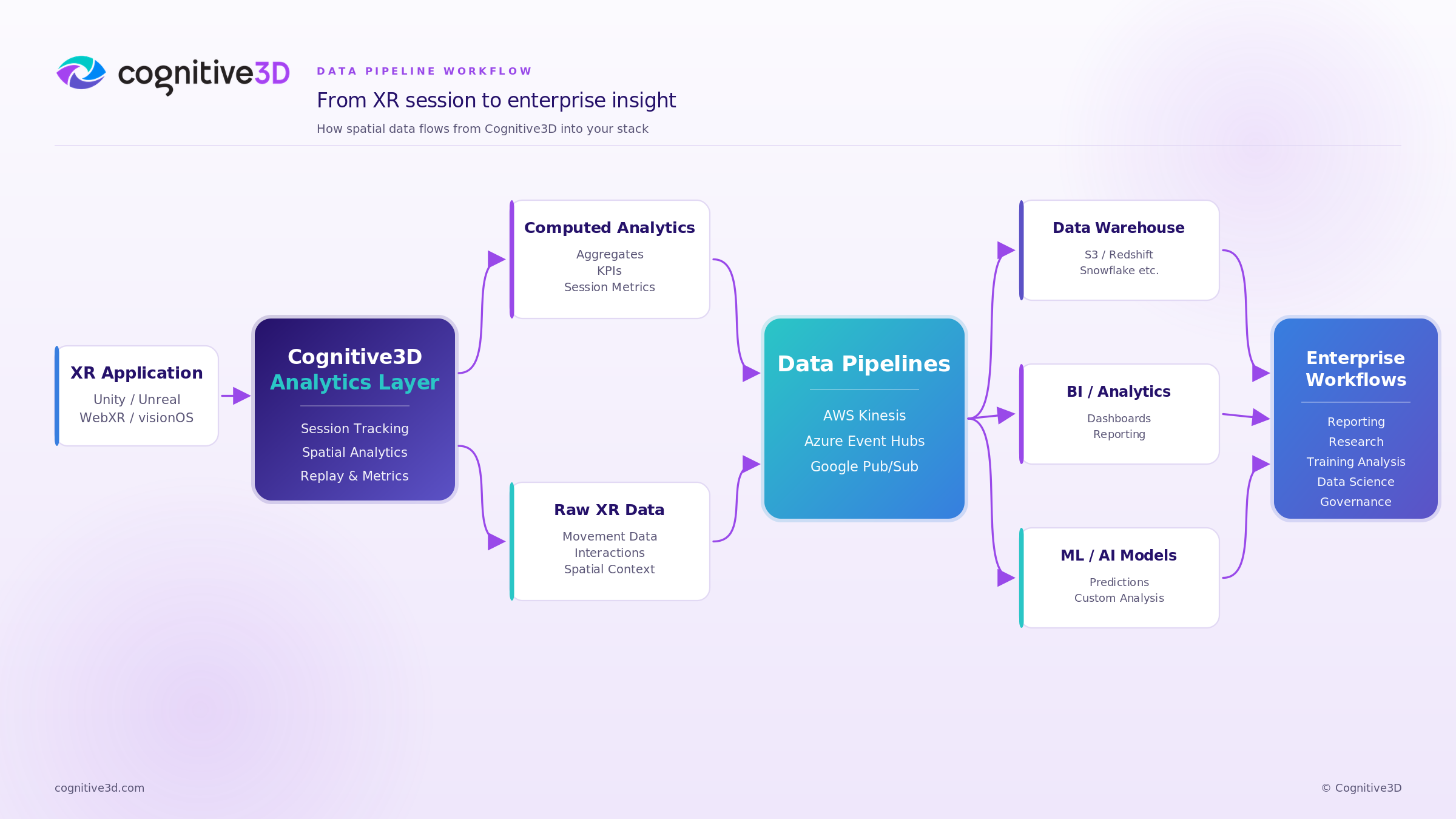
Data Pipelines supports both computed analytics exports and raw data streaming, giving teams flexibility depending on their technical needs.
Computed analytics data includes the insights already generated within Cognitive3D, such as session metrics, behavioural trends, and aggregate performance data. Exporting this data makes it easy to extend existing insights into external dashboards or reporting tools without rebuilding the underlying logic.
Raw data streaming provides access to the underlying spatial and behavioural data captured during XR sessions. This includes movement, interactions, and environmental context that can be used for custom analytics workflows. Teams can build their own models, apply machine learning, or design specialized pipelines tailored to their use case.
By supporting both approaches, Data Pipelines enable everything from lightweight reporting integrations to advanced data science workflows.
Built for Modern Data Infrastructure
Data Pipelines integrate with widely used cloud streaming systems, including AWS Kinesis, Azure Event Hubs, and Google Cloud Pub/Sub. These services act as the ingestion layer, allowing XR data to flow reliably into your infrastructure.
From there, data can be routed into storage systems, data lakes, or warehouses such as S3 or Redshift, depending on your architecture. Because these integrations rely on standard data streaming patterns, they fit naturally into existing pipelines without requiring custom infrastructure.
This means XR analytics can participate in real-time data processing, batch workflows, or hybrid models, depending on how your organization manages data.
What This Enables
When XR analytics data becomes part of your data pipeline, it can be combined with other datasets to create a more complete view of performance and behavior.
Teams can connect spatial data with internal systems such as training results, operational metrics, or user data. This allows organizations to move beyond isolated insights and understand how immersive experiences impact real-world outcomes.
Custom dashboards can be built using existing business intelligence tools, aligning XR analytics with broader reporting systems. For more advanced use cases, data science teams can apply predictive models or statistical analysis directly to behavioural data captured in immersive environments.
At the same time, Data Pipelines supports stronger data governance. By managing data within your own systems, you can enforce policies for storage, access, and compliance, which is especially important for enterprise and regulated environments.
Designed for Flexibility and Control
Data Pipelines is not just a feature for exporting data. It is a foundational capability that changes how XR analytics fits into an organization.
By enabling access to both processed insights and raw spatial data, it allows teams to define their own workflows and build systems that match their needs. Instead of relying on fixed platform capabilities, organizations can move data through their existing pipelines, from ingestion and streaming layers into storage, processing environments, and analytics systems.
In practice, this means XR session data can be captured, streamed through services like Kinesis, Event Hubs, or Pub/Sub, and delivered into storage layers or data warehouses where it becomes part of a broader dataset. From there, teams can query it alongside internal data, build dashboards in their preferred tools, or apply machine learning models to uncover patterns and predict outcomes.
This flexibility supports a wide range of use cases, from extending existing reporting workflows to building fully custom analytics and data science environments. At the same time, it gives organizations control over how data is stored, processed, and governed within their own infrastructure.
As organizations continue to invest in data-driven decision-making, integrating XR analytics into broader data systems becomes increasingly important. Data Pipelines ensures that spatial data can be used in the same way as any other critical data source, without being isolated or constrained by platform boundaries.
Bringing XR Data Into Your Ecosystem
Cognitive3D has always focused on making spatial behaviour observable, measurable, and actionable within immersive environments. The core value has been the ability to see what users did, understand how they interacted with a space, and analyze patterns across sessions.
Data Pipelines extends that model beyond the platform itself by allowing XR analytics data to move into your own data infrastructure. Instead of being confined to a single interface or set of tools, spatial data can now be stored, processed, and analyzed alongside the rest of your organization’s data. This creates a more complete and connected view of performance, where insights from immersive experiences can be evaluated in the same context as operational, training, or business data.
This shift is important because it changes how XR analytics are used. Rather than being a standalone layer for observation, it becomes part of a broader system for decision-making. Teams can define their own workflows, build their own models, and integrate spatial data into processes that already exist across the organization.
It also reinforces control. By keeping data within your own environment, you can manage how it is stored, governed, and accessed according to your internal requirements. For organizations with strict privacy, compliance, or data sovereignty needs, this is often a critical factor in scaling XR initiatives.
As a result, XR analytics are no longer limited to what can be explored in a dashboard. It becomes a flexible data source that can support reporting, research, and advanced analytics across teams. Data Pipelines makes it possible to move from isolated insight to integrated understanding, where spatial data contributes directly to how decisions are made.
Contact Cognitive3D to learn more!
Ready To See Inside Your XR App?
Start capturing real user behaviour, app activity, and device inputs in full 3D.