Game Designs Backed by Behaviour: XR Analytics for Better Builds


XR Studios Need Behavioural Evidence, Not Guesswork
XR games and entertainment experiences are expensive to build, difficult to validate, and easy to misread. A player might quit during onboarding, miss a critical object, avoid an important area of a scene, feel uncomfortable during locomotion, or abandon a build without ever explaining why. In traditional development workflows, many of these moments are interpreted through incomplete evidence such as survey responses, bug reports, crash logs, or internal playtest notes.
Cognitive3D helps studios replace that guesswork with spatial evidence. By capturing what players did, where they looked, how they moved, what they interacted with, and where they dropped off, Cognitive3D gives teams a clearer understanding of how their XR experiences are actually being used. This allows studios to make better design decisions, reduce wasted development cycles, and improve the commercial performance of their games and entertainment products.
The ROI Challenge in XR Game Development
The challenge with XR is that the most important product signals often happen inside the 3D environment. A player may fail to complete a tutorial not because the objective is too hard, but because the prompt was never noticed. A user may avoid a major scene not because the content is unappealing, but because the layout subtly pushes them elsewhere. A player may stop a session early not because they disliked the game, but because a locomotion moment caused discomfort.
Traditional analytics can show that something happened, but they rarely provide the spatial context needed to understand why it happened. Cognitive3D helps close that gap by giving teams a complete behavioural record of XR sessions. Studios can track experiences, replay individual sessions, and analyze aggregate patterns across many players to understand what is working, what is failing, and what needs to change.
Reduce Onboarding Drop-Off
Onboarding is one of the most important moments in an XR game. If players fail to understand the controls, miss an instruction, or become confused during the tutorial, they may leave before they ever experience the core value of the game. For studios, that means lost engagement, weaker retention, and less reliable feedback from early playtests.
Cognitive3D helps teams define goal steps for each tutorial moment and measure how players move through those steps. Studios can compare completion rates, review how long each step takes, and identify exactly where players drop off. When a player quits, the team can replay that session in 3D to see what the player was doing immediately before leaving. This makes it much easier to separate a minor usability issue from a major onboarding blocker.
The ROI comes from faster diagnosis and more focused iteration. Instead of redesigning an entire tutorial based on general feedback, teams can identify the specific step, object, prompt, or interaction that caused friction. This helps reduce early churn, shortens review cycles, and gives producers a clear evidence base for prioritizing fixes in the next sprint.
Improve Level and Scene Design With Real Player Movement
In XR, level design is not only about how a scene looks. It is also about how players physically move, where they pause, what they notice, and which areas they ignore. A level may look intuitive to the design team but behave very differently once real players enter the experience.
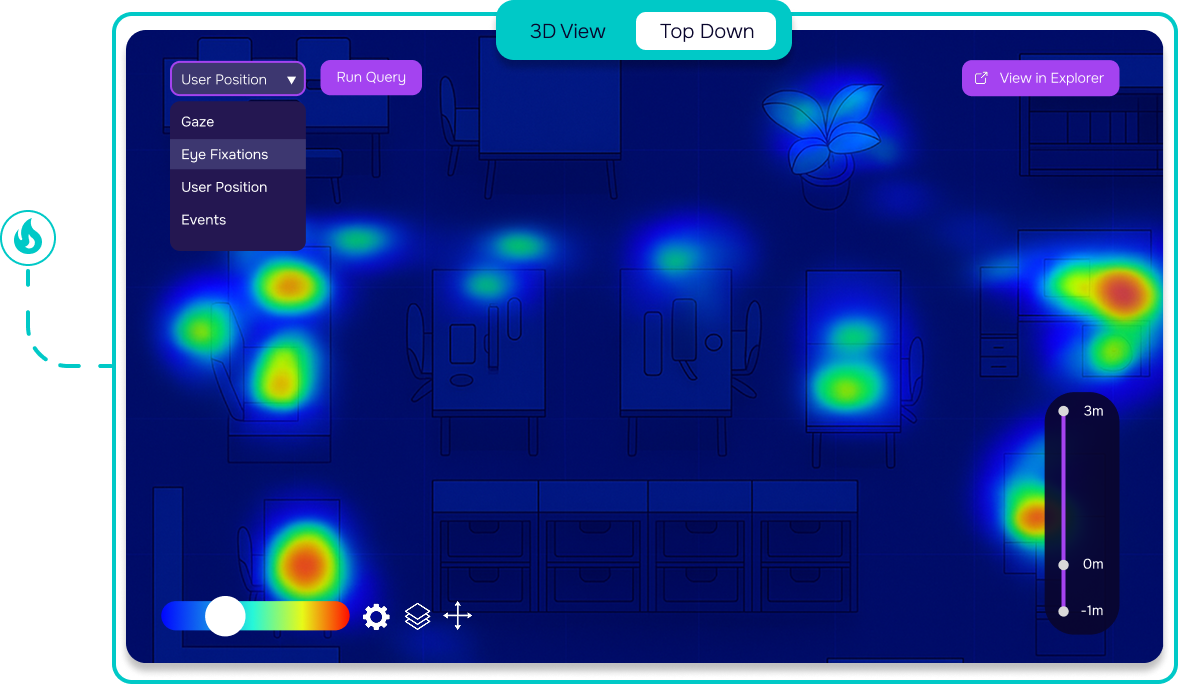
Cognitive3D gives studios tools such as navigation trails, traffic hotspots, gaze heatmaps, and object engagement data to understand how players actually move through a scene. Teams can see which paths players take, where attention lands, which areas become dead zones, and whether important objects are being noticed or ignored. When multiple player paths are overlaid, patterns begin to emerge that are difficult to see from individual notes or standard analytics alone.
This improves ROI by helping studios invest their design time where it matters most. Underused areas can be redesigned before more content is built around them. Confusing routes can be simplified before they damage engagement. Important visual cues can be repositioned if players are not seeing them. Most importantly, design discussions become grounded in observed behaviour rather than internal preference.
Catch Comfort and Locomotion Issues Before They Hurt Reviews
Comfort is a major factor in XR game success. Motion sickness, locomotion friction, and physical strain can all cause players to leave an experience, even when the game itself is compelling. The problem is that players do not always report discomfort clearly. Many simply remove the headset, end the session, or avoid returning.
Cognitive3D helps teams identify comfort issues by tracking session length, abrupt exits, movement patterns, and moments where players disengage. Studios can replay early-exit sessions with movement and gaze data overlaid to understand what was happening at the moment discomfort appeared. This can reveal whether the issue came from a specific locomotion mechanic, camera movement, scene transition, or environmental design choice.
The business value is significant because comfort issues can quickly affect reviews, retention, and word-of-mouth. By finding these issues before launch, studios can reduce the risk of avoidable negative feedback. They can also make more confident design changes because they are working from real player behaviour rather than waiting for complaints to appear after release.
Find Friction That QA and Bug Reports Miss
Not every product issue appears as a crash, error, or formal bug report. In many cases, the most damaging friction is silent. A player fails an objective, struggles with an interaction, misses an expected path, or quits without explaining what went wrong. These moments can be hard for QA teams to reproduce because there may be no obvious technical failure.
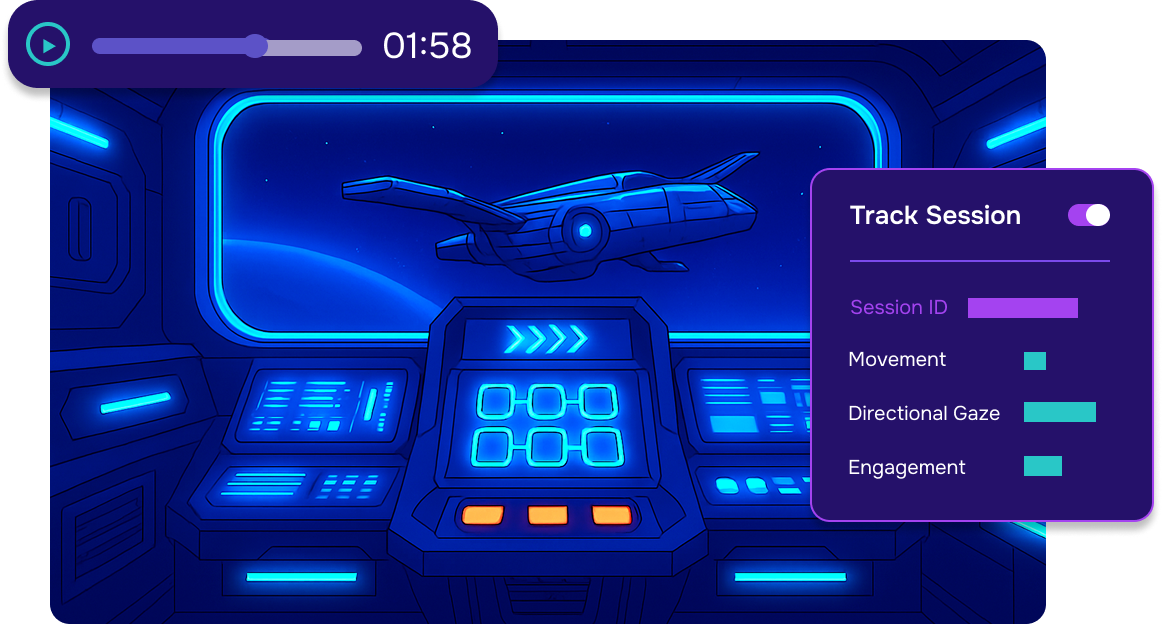
Cognitive3D helps studios turn silent abandonment into actionable evidence. Teams can tag sessions where players failed an objective, exited unexpectedly, or showed signs of friction. Those sessions can then be reviewed in 3D with gaze, movement, and input data visible. By segmenting sessions by build, device, scene, or player behaviour, QA teams can identify patterns that may not appear in traditional logs.
This improves ROI by reducing the time spent searching for hard-to-reproduce issues. Instead of relying on scattered feedback or forum posts, teams can review the exact in-scene behaviour that led to failure. This gives QA, design, and production teams a more reliable way to prioritize fixes and improve build quality before release.
Compare Builds With Behaviour Instead of Opinion
Studios often need to choose between two design directions. Both may seem reasonable in an internal review, and both may have strong supporters. Without player evidence, these decisions can become subjective, political, or delayed.
Cognitive3D helps teams compare builds using measured behaviour. Sessions can be tagged by build version, and players can be asked to complete the same scenario across different variants. Studios can then compare goal outcomes, task timing, gaze patterns, movement paths, and session replays to see which version performs better in practice.
This creates a clearer ROI path because it reduces wasted development on weaker design directions. Teams can make decisions faster, defend those decisions with evidence, and align stakeholders around what players actually did. For milestone reviews, this is especially valuable because the team can move beyond preference and show the behavioural proof behind a recommendation.
Increase the Value of Every Playtest
Playtesting requires time, coordination, and budget. Studios need to recruit players, prepare builds, run sessions, observe behaviour, collect feedback, and decide what to change. When the evidence from those sessions is incomplete, the value of the playtest is limited.
Cognitive3D increases the return on each playtest by preserving more of what happened inside the experience. Teams can record XR sessions, capture detailed scenes, track object engagement, define goals and events, collect in-experience feedback, monitor app performance, and capture device inputs such as motion, perspective, gaze, and device metadata.
This means every session produces a richer evidence base. A single playtest can support individual session review, aggregate behaviour analysis, QA investigation, design validation, and stakeholder reporting. Instead of relying only on what players remember after the session, teams can connect feedback to what the player was actually doing at the time. That makes each playtest more useful and helps studios learn more from the same testing budget.
Help Design, QA, Product, & Production Teams Move Faster
XR development can slow down when different teams interpret player behaviour differently. Designers may focus on scene flow, QA may focus on reproducibility, producers may focus on schedule risk, and leadership may want proof that the experience is improving. Without a shared source of evidence, these conversations can become slow and subjective.
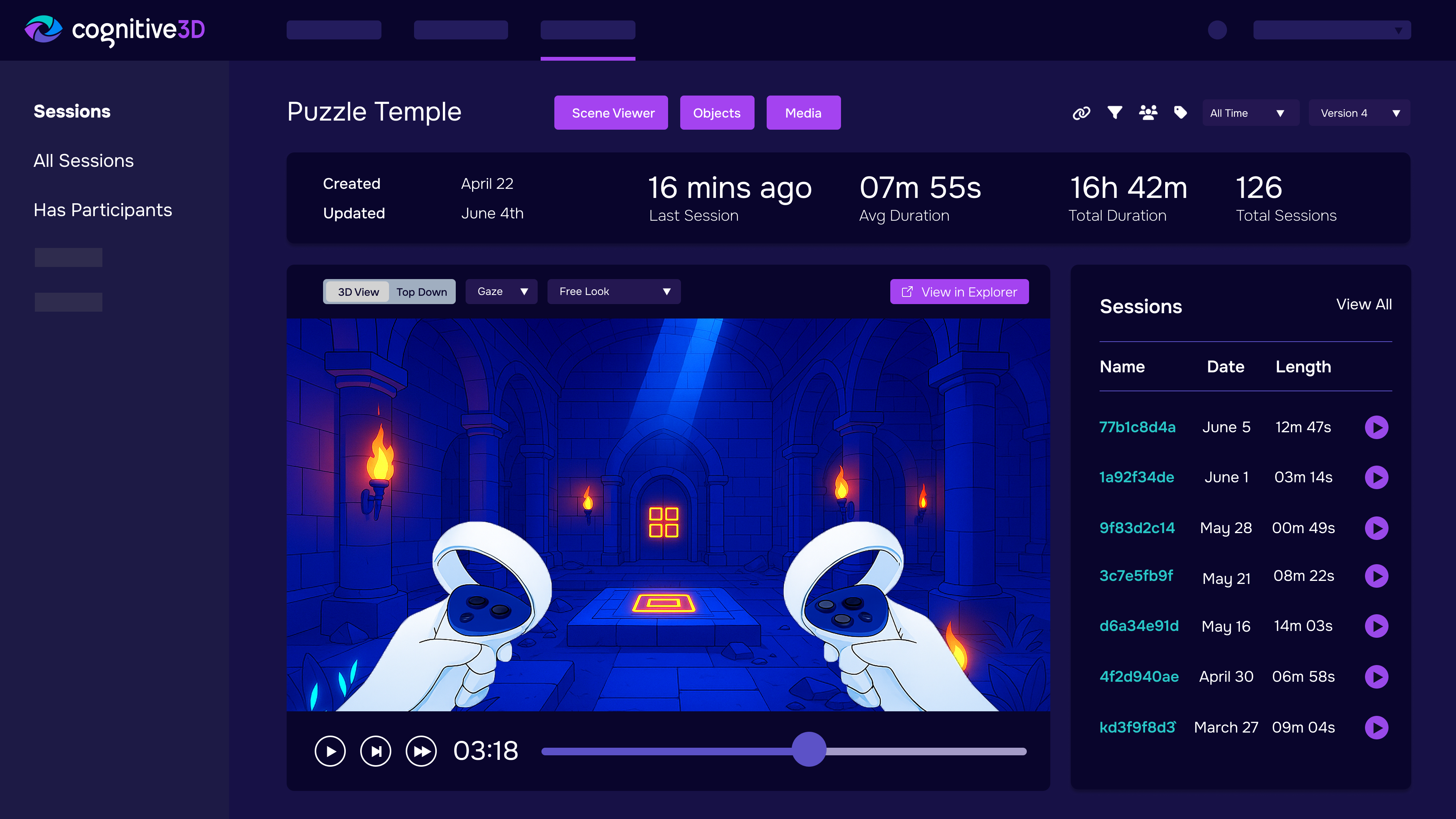
Cognitive3D gives teams a common view of player behaviour. Individual 3D session replay shows what happened in a specific session, while aggregate insights show whether that behaviour is part of a broader pattern. Teams can review how players moved, where they looked, which goals they completed, how objects were used, and where sessions ended.
This shared evidence helps teams make decisions faster. Designers can see which areas need refinement. QA can identify issues that deserve deeper investigation. Product and production leaders can prioritize work based on impact. Executives can review clear behavioural evidence instead of abstract reports. The result is a more efficient development process with fewer delays caused by uncertainty or disagreement.
Support Better Commercial Outcomes
The value of Cognitive3D is not simply that it provides more analytics. The value is that it helps studios improve the factors that influence commercial performance. Better onboarding can improve activation. Better scene design can improve engagement. Better comfort can improve session length and reviews. Better QA evidence can improve launch quality. Better build comparisons can reduce wasted development time. Better playtest insight can improve creative confidence.
For games and entertainment companies, these improvements can compound across the development cycle. A studio that identifies tutorial friction earlier, validates level design faster, catches comfort issues before launch, and chooses stronger build variants is better positioned to create an XR experience that players understand, enjoy, and return to.
Cognitive3D also provides scale and credibility for teams evaluating the platform. The company reports more than 181 million minutes of XR activity captured, more than 17 million sessions available for 3D replay, more than 543 billion device inputs captured, more than 36 million goals evaluated, and more than 1,400 companies on the platform.
The Bottom Line
XR studios do not need more guesswork, they need evidence they can act on. Cognitive3D helps games and entertainment companies improve ROI by showing what players actually do inside XR experiences. It helps teams find onboarding friction, validate level design, identify comfort issues, reproduce hidden bugs, compare builds, and make faster design decisions with spatial proof.
The fastest way to understand the value is to instrument a build and replay real player sessions in 3D. When teams can see gaze, movement, objectives, inputs, and behaviour together, they can make better decisions about what to fix, what to improve, and what to build next.
For development studios, Cognitive3D analytics is not just a reporting layer. It is a way to make XR development more measurable, collaborative, and commercially focused. By capturing real player behaviour inside the 3D experience, studios can identify what is working, uncover friction that would otherwise stay hidden, and make confident decisions across design, QA, production, and leadership.
The sooner teams instrument a build, the sooner they can stop relying on guesswork and start using spatial evidence to improve onboarding, comfort, engagement, and overall player experience. Cognitive3D helps studios build better XR products by showing them exactly how players experience them.
Ready To See Inside Your XR App?
Start capturing real user behaviour, app activity, and device inputs in full 3D.