Measuring ROI in AEC: How Virtual 3D Spaces Turn Design Review Into Business Evidence


Why AEC Teams Are Moving From Visualization to Validation
Architecture, Engineering, and Construction, often shortened to AEC, is the industry responsible for designing, planning, engineering, building, and maintaining the physical environments people use every day. It includes commercial buildings, hospitals, schools, transit hubs, office towers, campuses, public infrastructure, entertainment venues, and mixed-use developments. In each of these spaces, teams make thousands of decisions before a project ever becomes real. This can include how people will move through a lobby, whether a room layout supports its intended use, whether signage will help visitors find their way, or whether the final design is worth the cost of building.
For AEC teams, the ability to take advantage of virtual 3D spaces is changing what design review can accomplish. Instead of relying only on drawings, renderings, BIM models, and stakeholder walkthroughs, teams can place reviewers, clients, employees, guests, patients, or end users inside a virtual version of the space before construction begins. These virtual environments can replicate proposed scenes in 3D, including digital twin-style representations of buildings, rooms, layouts, objects, and spatial relationships that help teams experience a design before it exists physically.
The value of these virtual 3D spaces is not limited to visualization. A digital twin, VR walkthrough, or immersive model can help a stakeholder understand what a future space may look and feel like, but the real business value comes from measuring what happens inside that environment. When people move through a replicated 3D scene, they reveal whether the design works in practice, where they pause, what they miss, how they navigate, and whether the space supports the task it was designed to enable.
Cognitive3D helps AEC teams turn those immersive experiences into measurable design evidence. The platform captures what reviewers and end users actually did, where they looked, how they moved, where they paused, which tasks they completed, and where the design created confusion or friction. That means a design review can move beyond opinions and impressions into observed behaviour. The real question is no longer whether stakeholders liked the design. It is whether the design can prove it works before it becomes expensive to change.
For AEC leaders, that is the business case. When teams can validate a design in a virtual 3D space before construction, they can catch issues earlier, defend design changes with evidence, reduce rework risk, improve stakeholder alignment, and make more confident decisions before budgets are committed.
AEC Teams Need More than Visual Review
A beautiful rendering can show what a space might look like, a BIM model can show how a space is structured, a digital twin can replicate the physical or planned environment in a virtual 3D world, and a design presentation can explain how the building is intended to function. These tools are essential to modern AEC workflows, but they do not automatically prove how people will actually behave inside the space.
This distinction matters because buildings are not experienced as static visuals. People move through them, hesitate, turn around, miss signs, follow unexpected routes, crowd around certain areas, and ignore others entirely. A corridor that looks clear in a model may feel confusing in use, while a lobby that appears intuitive in a rendering may not guide visitors toward the right destination. A proposed workplace layout may look efficient on plan but fail to match how employees actually move, focus, and collaborate.
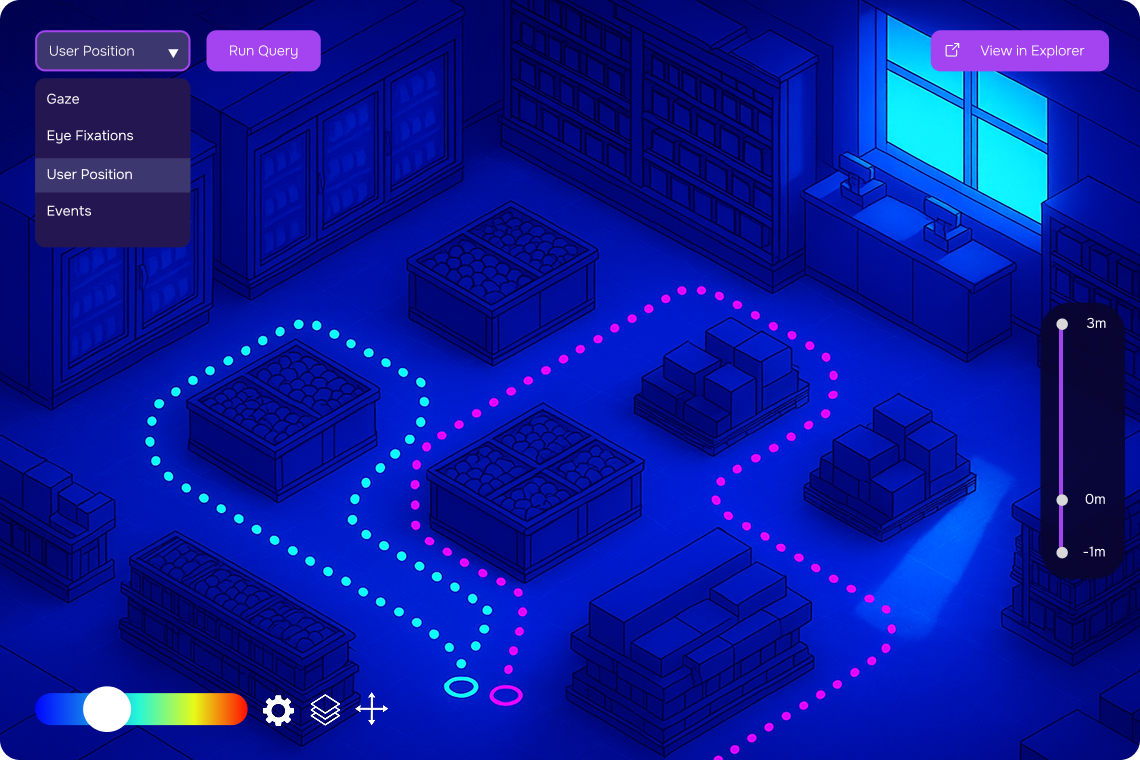
Virtual 3D spaces allow AEC teams to test those behaviours before the building exists. Cognitive3D adds the analytics layer that makes those tests useful for business decisions. Instead of relying on someone’s memory after a walkthrough, teams can replay the session, inspect movement paths, review gaze and attention data where enabled, compare cohorts, and analyze patterns across multiple participants.
This creates a stronger evidence base for design validation. AEC teams can use virtual environments not only to show what has been designed, but to evaluate whether that design works for the people who will eventually use it.
Pre-Construction Design Validation Means Catching Costly Issues Earlier
One of the most direct business use cases for AEC is pre-construction design validation. In a traditional workflow, an issue may not become obvious until the project is already in construction or, worse, after the building opens. By that point, changes are harder to make, more expensive to defend, and more disruptive to the project schedule.
In a virtual 3D workflow, teams can test the proposed design while there is still time to adjust it. A replicated scene, immersive model, or digital twin-style environment gives reviewers a way to experience the design spatially before physical work begins. They can walk through the space, attempt realistic tasks, evaluate sightlines, inspect adjacencies, and experience scale in a way that is difficult to achieve through flat drawings or static images alone.
Cognitive3D can record movement, gaze, and dwell time across a VR walkthrough. Teams can then compare sessions to identify where reviewers stalled, what features they missed, where they became disoriented, and whether the design communicated what it was supposed to communicate.
For architecture teams, this can support clearer design decisions. For engineering teams, it can reveal whether spatial systems, access points, and operational flows make sense to the people who will use or maintain the space. For construction teams, it can reduce downstream ambiguity by surfacing design concerns before physical work begins. For owners and developers, it creates a more defensible reason to approve, revise, or challenge a design before costs escalate.
Turning Virtual Walkthroughs into Measurable Proof
AEC teams already use 3D models, digital twins, VR walkthroughs, and immersive presentations to communicate ideas. The gap is that many of those experiences still end with qualitative feedback. Stakeholders may say that a space feels clear, a hallway seems narrow, a lobby looks intuitive, or a proposed route appears easy to follow. These reactions are useful, but they are not always enough to support a budget conversation, construction change, client approval, or operational decision.
Cognitive3D turns the walkthrough into a data source. A team can see how each participant moved through the environment, replay an individual session in 3D, and review what the user looked at when supported gaze or eye-tracking data is available. Teams can also define goals, such as finding the reception desk, locating an elevator, completing a route to an exit, reaching a service counter, or identifying a key design feature. They can then measure whether participants completed those goals and where they encountered friction.
This matters because business confidence in AEC industries depends on reducing uncertainty. The more clearly a team can show what happened inside a virtual space, the easier it becomes to explain why a design should change, why a decision should move forward, or why a concern needs attention now rather than later.
Moving From 3D Models to Measurable Digital Twins
A major advantage of virtual 3D spaces is that AEC teams can recreate the context around a decision, not just the object being reviewed. A digital twin-style environment can preserve the relationship between walls, corridors, entrances, signage, fixtures, furniture, lighting, sightlines, and circulation paths. This spatial context is what allows teams to understand how a person experiences the design as a connected environment.
Cognitive3D supports this by helping teams capture and review detailed 3D scenes as part of the XR analytics workflow. When a scene is represented in 3D, session data has context. Movement trails can be understood in relation to hallways and destination points. Gaze data can be interpreted against signs, objects, or visual landmarks. Goal completion can be evaluated within the actual spatial layout rather than as an isolated event.
This is important for AEC industries because the same behaviour can mean different things depending on where it occurs. A long pause in a lobby may indicate confusion, interest, congestion, or a decision point. A missed turn may suggest a signage issue, a layout issue, or a mismatch between user expectations and environmental cues.
A digital twin-style scene gives teams the spatial record they need to interpret those signals more accurately.
Use Wayfinding to Validate Movement Before the Public Arrives
Wayfinding is a high-impact AEC use case because it directly affects how people experience a building. In hospitals, airports, transit centers, universities, corporate campuses, civic buildings, and large commercial spaces, poor wayfinding creates more than inconvenience. It can increase staff interruptions, slow movement, frustrate visitors, create accessibility challenges, and damage the reputation of the space.
The problem is that reviewers are not always good at predicting which signs will work before the building opens. A sign can appear clear in a design review but fail when a person is moving through a space, making decisions under time pressure, or approaching from an unexpected angle. A route can seem obvious to the project team because they already know the building, while first-time visitors experience it very differently.
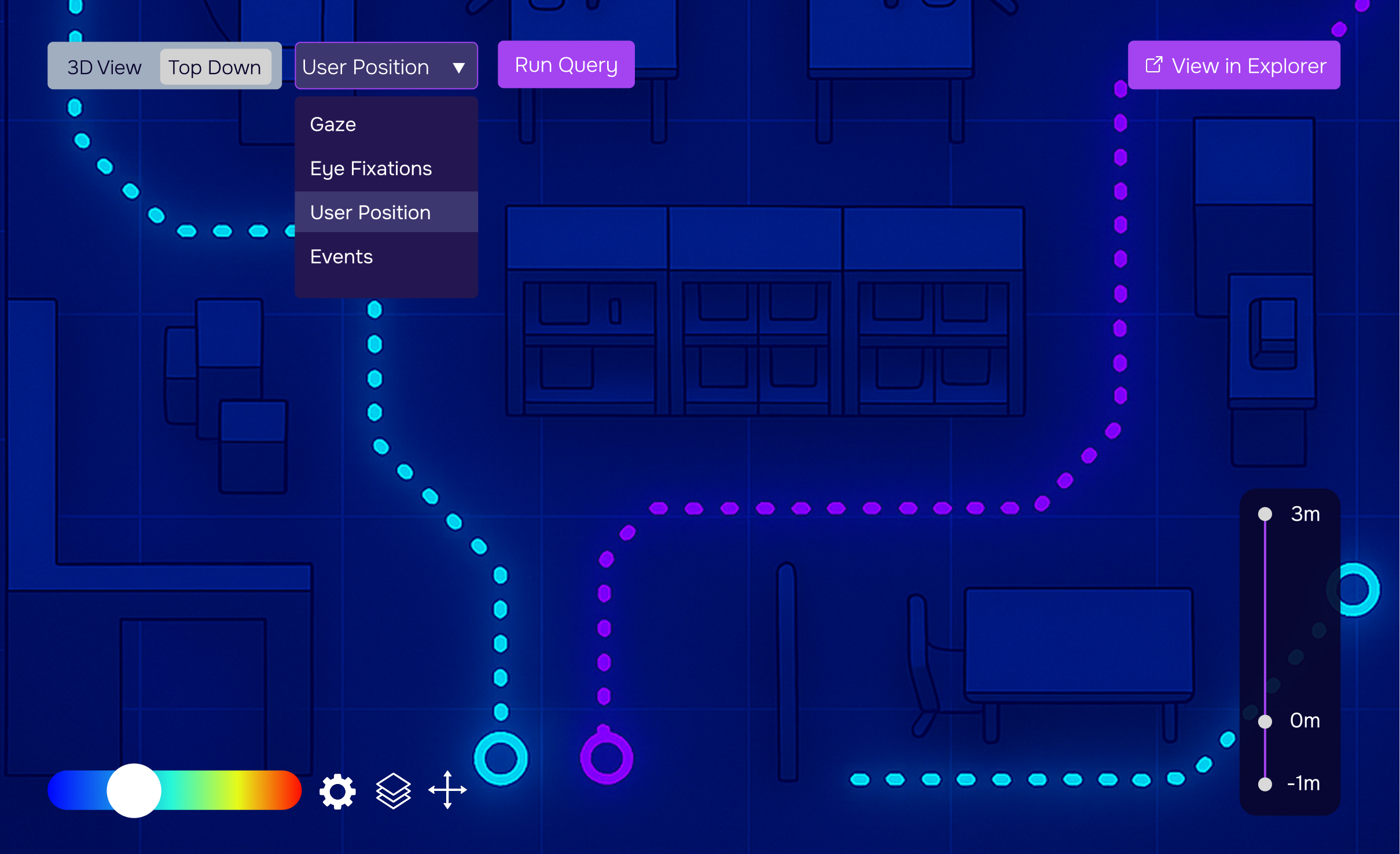
In a virtual 3D environment, AEC teams can test wayfinding before physical signage is fabricated or installed. Participants can be given realistic tasks, such as finding a clinic, locating a platform, reaching a meeting room, navigating from parking to reception, or exiting after an event. Cognitive3D can capture each participant’s path, pause points, and what they looked at when they became stuck. Movement overlays and heatmaps help separate signage that worked from signage that did not. This results in the creation of a pre-build correction list grounded in observed behaviour rather than subjective feedback.
For AEC teams, that means wayfinding can be evaluated as part of the design process instead of being fixed after opening. It gives architects, owners, operators, and signage teams a more objective way to identify where clarity breaks down and what should be improved before the building is occupied.
Making Stakeholder Alignment Easier to Defend
AEC projects bring together many stakeholders, including architects, engineers, contractors, owners, developers, facilities teams, operators, public agencies, accessibility consultants, finance leaders, and end users. Each group sees the project through a different lens. A designer may care about experience and intent, an engineer may care about systems and feasibility, a contractor may care about constructability, and an owner may care about cost, risk, and asset performance.
Virtual 3D spaces help these groups align because they can experience the same proposed environment. A digital twin or immersive model gives stakeholders a shared reference point for discussing how the space should work. Cognitive3D strengthens that alignment by adding evidence to the conversation. Teams can show where people moved, where they slowed down, where they missed key elements, and where different cohorts behaved differently.
This makes design conversations less dependent on preference alone. Instead of debating whose opinion should carry more weight, teams can ask what users actually did, where behaviour matched the design intent, where behaviour revealed friction, and which issues appeared repeatedly across multiple sessions. This is where Cognitive3D becomes valuable not only for design teams, but also for the business side of AEC.
Testing Workplace and Facilities Plans Before Capital Is Committed
AEC decisions do not stop at the shell of the building. Workplace and facilities planning also carry major financial implications. Corporate real estate, tenant improvements, hybrid workplace design, and office buildouts all depend on assumptions about how people will use space. Teams may plan focus pods, collaboration zones, shared desks, meeting areas, and circulation paths based on workplace strategy, surveys, or leadership preferences.
The challenge is that planned use is not always the same as observed use. A workplace concept can look efficient in a model but fail to support the way employees actually move, collaborate, concentrate, or transition between tasks. A common area may be overbuilt, a focus space may be hard to find, or a circulation path may create unnecessary friction during peak usage.
Cognitive3D can help teams test proposed workplace designs in virtual 3D before a lease is signed or a buildout begins. Employees can move through a proposed floor plan, complete realistic tasks, and interact with the layout as if it were real. The platform can then measure how they use common areas, focus spaces, hot desks, and circulation routes.
This gives teams a stronger way to show how a proposed workplace can support real employee behaviour across roles, helping finance and facilities leaders move forward with greater confidence in decisions around floor plans, shared spaces, focus areas, and workplace features.
It can help determine whether the design supports actual work patterns, whether certain amenities are likely to be used, and whether the proposed layout justifies the cost of construction or buildout. Those answers can directly affect cost per square foot, space utilization, employee experience, and long-term workplace performance.
Designing More Inclusive Spaces With Better Evidence
Inclusive design is another area where virtual 3D spaces can create significant business and human value. Many accessibility issues are difficult to retrofit cleanly after a building opens. They can also create reputational risk, compliance pressure, operational challenges, and real barriers for the people who need the space to work for them.
The challenge is that a standard review group may not experience the same friction as users with mobility, sensory, or cognitive differences. A route that seems simple to one reviewer may be confusing, tiring, inaccessible, or stressful for another. A doorway, sign, counter, transition, or route may technically appear acceptable in review but still create a poor experience for certain users.
Cognitive3D can support accessibility and inclusive design reviews by comparing cohorts in the same virtual environment. Teams can run sessions with an accessibility cohort alongside a baseline group, then capture paths, pauses, reach points, and friction.
For AEC teams, this can make inclusive design more observable. It does not replace formal accessibility expertise or compliance review, but it gives teams a way to see how different users experience the space before physical changes become costly.
What Cognitive3D Makes Possible Inside Virtual 3D Spaces
The value of Cognitive3D for AEC is that it connects immersive review to measurable behavioural insight. AEC teams can use virtual 3D environments, digital twin-style scenes, and VR walkthroughs not only to communicate a proposed design, but to evaluate how people behave inside that design.
The platform supports three major parts of the workflow.
First, teams can track their XR experiences by capturing detailed scenes, recording XR sessions, tracking movement, recording where users look with supported hardware, defining goals and events, collecting feedback in XR, and monitoring app performance.
Then teams can explore individual behaviour by replaying a session in 3D, following how a user moved, seeing where a user looked, evaluating how they performed against a task, and reviewing a timeline of activity.
Finally, teams can analyze the aggregate insights by comparing sessions, seeing how users navigate, visualizing focus patterns, analyzing goal performance, segmenting by cohort, and querying the data to find patterns across users.
That combination is what makes the business case stronger. AEC teams are not just building a more impressive presentation. They are building a measurable testing environment for decisions that will later affect construction cost, operational performance, user experience, accessibility, and asset value.
Fewer Assumptions and Stronger Design Decisions
The value of Cognitive3D in AEC comes from helping teams make expensive decisions with better evidence. It can help reduce late-stage rework by finding design issues earlier, improve stakeholder confidence by turning walkthroughs into measurable proof, and support owner and client conversations with observed behaviour instead of subjective impressions.
It can also help validate wayfinding, accessibility, workplace use, and operational flow before the space is built. By showing where users actually struggled, Cognitive3D can help teams prioritize which design changes matter most and which issues may have the greatest downstream impact. It also helps AEC teams get more value from the virtual 3D environments they are already creating, including digital twins, immersive design models, and VR walkthroughs.
With Cognitive3D, those 3D environments become measurable. Teams can observe behaviour, compare outcomes, and turn immersive walkthroughs into evidence that supports real business decisions.
From Design Review to Design Proof
AEC industries have always depended on visualization. Drawings, models, renderings, BIM workflows, digital twins, and walkthroughs help teams imagine what a future space could become. The next step is proof.
Cognitive3D helps teams understand what actually happens when people experience a proposed space in XR. It gives AEC teams the ability to test, measure, replay, compare, and defend design decisions before the project becomes physical.
That is the shift from review to evidence, from assumptions to observed behaviour, and from virtual 3D space to measurable business impact.
Turn Your Next Digital Twin Into a Measurable Design Review
The fastest way to evaluate the value is to instrument one scenario. Choose one important design question, such as a lobby flow, a signage route, an accessibility path, a workplace floor plan, a guest journey, or a pre-construction walkthrough.
Then bring users into the virtual space, record what happens, and review the evidence in Cognitive3D. The best design conversation is no longer only, “What do we think?” It becomes, “What did the space actually prove?”.
Book a demo today to see how Cognitive3D can help your business make the most educated decisions possible.
Ready To See Inside Your XR App?
Start capturing real user behaviour, app activity, and device inputs in full 3D.