Cognitive3D and Zappar Bring Spatial Analytics to Mattercraft


Connecting Creation and Measurement
Creating immersive experiences has become dramatically easier over the last few years. Modern development tools now make it possible to build interactive 3D, AR, VR, and WebXR experiences without assembling a complex pipeline of engines, deployment tools, hosting infrastructure, and custom integrations. Platforms like Mattercraft have helped accelerate that shift by bringing visual editing, scripting, collaboration, and publishing into a single browser-based workflow, allowing developers and creative teams to move from concept to deployment faster than ever before.
Yet launching an immersive experience is only part of the challenge. Once users begin interacting with that experience, teams still need a reliable way to understand what happened, what worked, and where improvements can be made. Did users notice the content that mattered most? Did they complete critical tasks? Did they engage with products as intended? Did they become confused, distracted, or disengaged at key moments? These questions become increasingly important as XR moves from experimentation into production deployments where outcomes matter.
Today, we’re excited to announce a new integration between Cognitive3D and Zappar’s Mattercraft platform that helps answer those questions. By bringing spatial analytics directly into the Mattercraft ecosystem, developers and organizations can now measure what users actually do inside immersive experiences on the platform, and use that information to improve future versions with confidence.
Why Spatial Analytics Matters
Traditional analytics platforms were designed for websites and mobile applications. They excel at measuring page views, sessions, clicks, conversions, and navigation paths. Those metrics are valuable, but immersive experiences introduce entirely new forms of behaviour that cannot be fully understood through conventional analytics events alone.
In XR environments, users move through space, examine objects from different angles, shift their attention between competing stimuli, and interact with content using natural movement and gestures. Much of the most important behaviour occurs between the moments that traditional analytics platforms are capable of recording. As a result, teams often find themselves trying to understand complex spatial experiences using tools that were never designed to capture spatial behaviour.
This visibility gap becomes especially important in training simulations, research environments, retail activations, and interactive product experiences. A user may complete a task successfully, but how they completed it can be just as important as the outcome itself. Did they hesitate before making a decision? Did they miss critical information? Did they spend more time with one object than another? Did experienced users behave differently from first-time participants? These are the kinds of questions that spatial analytics is designed to answer.
Rather than relying solely on surveys, assumptions, or post-experience feedback, spatial analytics captures behaviour within the context of the environment itself. Teams can see where users moved, what they looked at, how they interacted with objects, and how their behaviour changed over time. This transforms immersive experiences from something that is difficult to evaluate into something that can be measured, analyzed, and continuously improved.
Bringing Spatial Analytics Into Mattercraft
Mattercraft has established itself as one of the industry’s most flexible platforms for building and publishing immersive content for the web. Developers can create experiences using a visual 3D editor, TypeScript scripting, physics systems, animation tools, collaboration workflows, and NPM package support, then publish those experiences across web, AR, VR, and WebXR environments from a single platform.
The new Cognitive3D integration extends those capabilities by adding a behavioural measurement layer directly into the development workflow. Mattercraft users can install Cognitive3D through the built-in dependencies browser using either the @cognitive3d/three-mattercraft package for WebAR experiences or the @cognitive3d/zappar-three package for headset-based WebXR projects. Once connected, developers can begin capturing spatial session data without fundamentally changing how they build and deploy experiences.
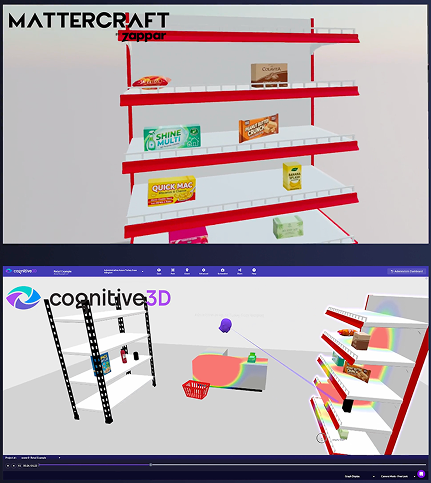
The integration records a wide range of behavioural and technical signals, including user movement, headset perspective, object engagement, gaze, goals, interactions, and performance events. That data is then available inside Cognitive3D’s analytics platform, where teams can explore aggregate trends, review session-level details, and replay entire experiences in 3D. Instead of looking at isolated events, teams gain access to a complete behavioural record that provides context around how users experienced the environment.
This combination creates a powerful connection between creation and measurement. Mattercraft provides the tools needed to build immersive experiences, while Cognitive3D provides the tools needed to understand how those experiences perform once they reach real users.
From Publishing to Understanding
One of the most significant outcomes of this integration is the creation of a complete feedback loop for immersive development. Historically, many XR teams have invested substantial effort into building and launching experiences but had limited visibility into what happened after deployment. Understanding user behaviour often required custom instrumentation, manual observation, or extensive qualitative research.
With Cognitive3D integrated directly into Mattercraft, the workflow becomes much more straightforward: build, publish, measure, and improve. Teams can move from creating experiences to understanding behaviour without introducing additional analytics infrastructure or complicated reporting systems.
This feedback loop is becoming increasingly important as immersive technologies mature. Enterprise training teams need evidence that simulations are improving performance and supporting learning objectives. Researchers need reliable behavioural data to supplement observational studies. Brand and retail teams need to understand engagement beyond impressions and clicks. Product teams need insight into how users interact with spatial interfaces and virtual environments.
Across all of these use cases, organizations are increasingly asking the same question: how do we know this is working? Spatial analytics helps provide an answer by replacing assumptions with observable behaviour and helping teams make decisions based on evidence rather than intuition.
A Natural Partnership
The Cognitive3D and Zappar integration began through collaboration between the two companies’ engineering teams in late 2025. From the outset, the goal was straightforward: make advanced XR measurement available inside one of the industry’s most capable web-based 3D authoring environments.
As development progressed, it became clear that the partnership addressed a growing need within the XR ecosystem. Creation tools have evolved rapidly, making it easier than ever to build immersive content. At the same time, organizations are demanding stronger evidence around engagement, performance, learning outcomes, and business impact. Bringing creation and measurement together helps bridge that gap.
Early previews of the integration have already been shared with enterprise stakeholders, generating positive feedback. Zappar has also developed a retail demonstration environment showcasing the integration, while its in-house creative agency has incorporated Cognitive3D analytics into client offerings. These early implementations demonstrate how behavioural measurement can become a natural extension of the immersive development process rather than a separate workflow.
By combining Mattercraft’s authoring and publishing capabilities with Cognitive3D’s spatial analytics platform, developers gain a more complete toolkit for building experiences that are not only immersive, but measurable.
What’s Next
The integration is available today through NPM and can be added directly to Mattercraft projects. Both Cognitive3D and Zappar are showcasing the integration at AWE USA 2026, where attendees can see how immersive experiences built in Mattercraft can be instrumented, analyzed, and replayed using Cognitive3D’s spatial analytics platform.
Looking ahead, both companies are exploring opportunities to expand the integration further. Areas of focus include deeper Mattercraft template support, expanded mobile AR analytics capabilities, and additional workflow enhancements that help enterprise teams move more efficiently from development to measurement and optimization.
As immersive technologies continue to mature, measurement will become an increasingly important part of the development stack. Building great experiences remains essential, but understanding how those experiences perform in the real world is what enables continuous improvement. Through this partnership, Cognitive3D and Zappar are helping make that understanding more accessible to the teams building the next generation of immersive experiences.
Interested in partnering with Cognitive3D? We work with platforms, studios, and tools across the XR ecosystem to bring spatial analytics into the workflows teams already use. If you're building something where measurement would add value for your users and customers, we'd like to hear from you. Find out more here.
Ready To See Inside Your XR App?
Start capturing real user behaviour, app activity, and device inputs in full 3D.